
The corporate-tech milieu of A Vantage Mystery. The island. The firm. The kind of money that builds private networks and believes the security is in the encryption.

The World of A Vantage Mystery: A Dossier
The Firm
Vantage is a private intelligence firm operating out of London. It does not advertise. It does not maintain a public profile. New clients come by referral, and the referrals arrive through channels that are not documented in any way that a journalist could trace or a regulator could follow.
The firm handles situations. Not crimes, precisely, though crimes are often present. Not disputes, though disputes are always present. Situations: the category of problem that exists in the space between what the law can address and what the client can afford to have addressed by the law. Corporate predation that is legal but consequential. Information that has value to the wrong person. A crisis that has not yet become a crisis but will, unless someone with the right kind of intelligence intervenes first.

The team is four people. Nadia Calloway leads. She reads environments the way surveyors read land: systematically, with attention to what has been disturbed and what has been left deliberately in place. James Osei-Mensah reads architecture, both physical and organisational. He understands that the way a building is arranged tells you more about the people inside it than anything those people will volunteer. Rowan Sharp reads people: the micro-expressions, the rehearsed answers, the specific variety of composure that indicates someone is managing something they did not expect to be asked about. Elliot reads money, because money is always telling a story and the story is always more honest than the person who controls it.
They are very good at what they do. This is not a series about investigators who make mistakes. It is a series about investigators who are given the wrong brief and have to find the right one.
The Milieu
A Vantage Mystery operates in a specific stratum of contemporary Britain: the intersection of inherited wealth, new technology money, and the professional class that services both. The clients are people who exist several tax brackets above ordinary experience. The settings are places those clients go when they want to be away from accountability: private islands, wellness retreats, cruise ships, Scottish estates, properties that cost more to maintain per year than most people earn in a decade.
The crimes in this milieu are rarely the kind that announce themselves. They are the kind that require paperwork to execute and more paperwork to conceal. Algorithms are stolen the way land is stolen: slowly, legally, with documentation that makes the theft look like a transaction. Data is acquired, misattributed, laundered through acquisition disclosures and patent applications and non-disclosure agreements that say one thing in their title and something else in paragraph fourteen of their schedules.
The corporate-tech world is particularly suited to this kind of crime because it has built, at enormous expense, a vocabulary that makes predation sound like progress. Acquisitions become “integrations.” Intellectual property theft becomes “knowledge transfer.” Blackmail, when conducted through quarterly consulting retainers and strategic introductions, becomes “relationship management.” The people who work in this world are very intelligent and they know what is happening and they have decided to call it something else.
Vantage operates in the gap between what is called and what is actually happening. That gap is where the cases live.
The Settings
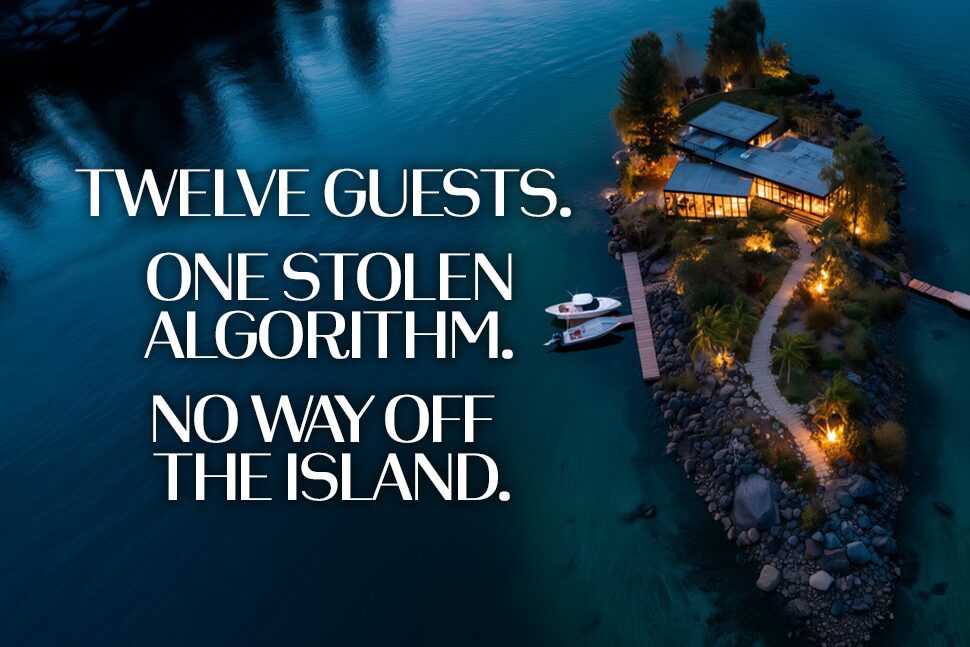
Each book in Arc 1 is set in a sealed environment. The environment is not decoration. It is a mechanism.
In Nothing To See Here, the private island off the Devon coast does three things simultaneously. It makes the suspect pool finite and verifiable. It removes the ordinary escape routes: no phone calls, no lawyers, no PR firms, no way to get your story out ahead of the investigation. And it concentrates pressure in a way that reveals what people look like when the ordinary infrastructure of plausible deniability has been taken away from them.
Marcus Hale chose this environment deliberately. He chose it the way he chose everything: as a display of control. The island is his. The network is his. The guest list is his. He invited the problem to his island because he believed that if he controlled the terrain, he controlled the outcome.
He was wrong about the terrain. He was wrong about the outcome.
The Architecture Beneath
The Vantage series is twenty books. The first six are self-contained cases. They are also something else, which becomes visible only in accumulation. Readers who follow the series from Book 1 through Book 6 will begin to notice things that a first-time reader will not. Not Easter eggs. Not deliberate red herrings. Details that are load-bearing in ways that only become clear later, in the way that a date handwritten in the corner of a thin file becomes significant only when you know what happened six months before the retreat.
The architecture beneath is not the point of any individual book. It is the point of the series. The cases are real investigations that resolve completely. The thread connecting them is something else entirely, and it takes twenty books to understand what it is.
That is the design. It was drawn by someone who is dead. Vantage does not know this yet.
Nothing To See Here is Case One.